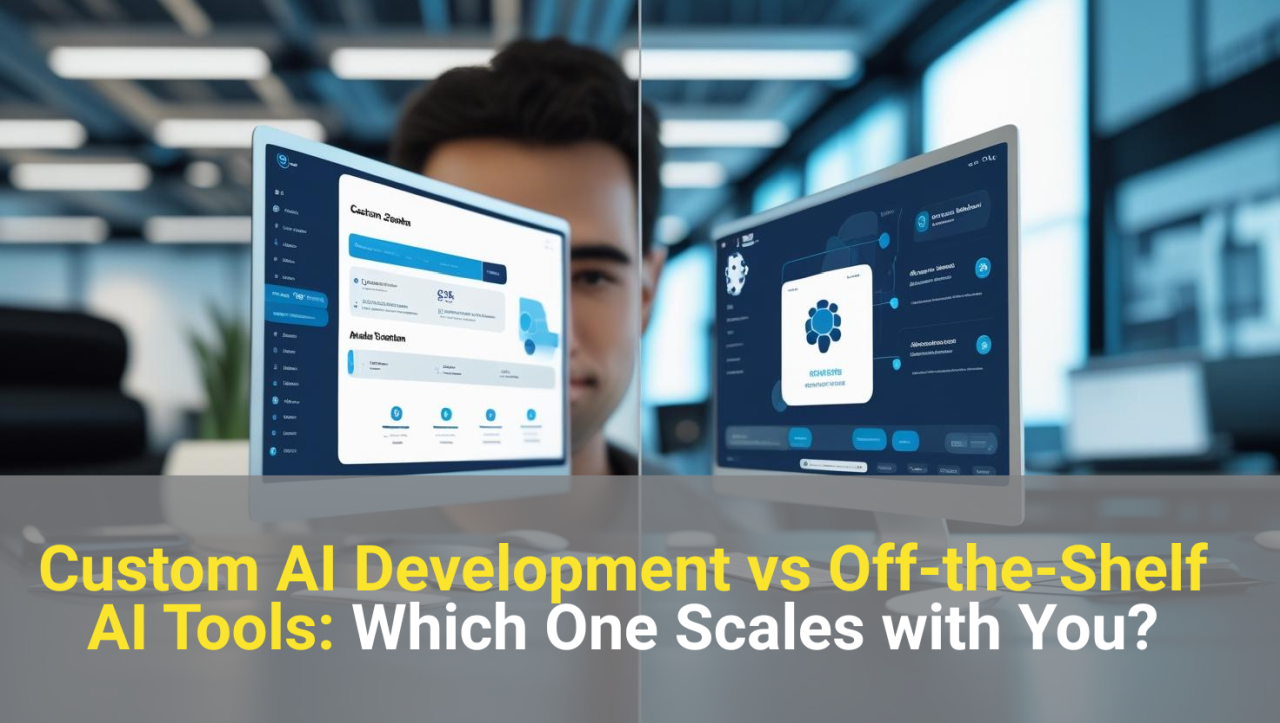
You started with an off-the-shelf AI tool. It worked at first. But now, your business is growing, your data is piling up, and those plug-and-play AI features aren’t keeping pace. Sound familiar?
Whether you’re hitting system limits, struggling with integration, or just feeling boxed in, you’re not alone. Many teams reach this same crossroads: Stick with off-the-shelf tools or invest in custom AI development?
This post breaks down the tradeoffs between both options through the lens of what matters most at scale: flexibility, performance, and long-term value.
What’s the Difference?
Off-the-Shelf AI Tools
These are ready-made AI products, tools like Jasper, Pictory, ChatGPT-powered plugins, or machine learning APIs from cloud providers.
Pros:
- Fast to deploy
- Lower upfront cost
- No AI expertise needed
Cons:
- Limited customization
- Feature gating as you grow
- Can’t always handle complex or unique workflows

Custom AI Development
This means building AI systems tailored to your specific business needs, data, and infrastructure—whether it’s a fine-tuned LLM, predictive model, or a fully integrated pipeline.
Pros:
- Fully tailored to your use case
- Scales with your infrastructure and data
- Enables long-term competitive advantage
Cons:
- Higher initial cost
- Requires technical expertise and time to build
The Real Question: Will It Scale With You?
Where Off-the-Shelf Tools Start Falling Short
At some point, prebuilt tools hit a ceiling:
- Usage limits start costing more than they save.
- Rigid workflows don’t map to your operations.
- Lack of integration leads to manual workarounds.
- Data privacy becomes a concern with shared or cloud-based models.
Why Custom AI Is Designed for Growth
Custom AI evolves as your business does:
- It’s trained on your unique data, not a generic dataset.
- You control how it’s deployed, optimized, and scaled.
- It can integrate directly into your systems—ERP, CRM, logistics, you name it.
Example: A logistics company that initially used off-the-shelf route optimization tools built a custom AI model that factored in warehouse delays, weather, and real-time inventory levels. The result? A 15% efficiency gain and total control over their stack.
Cost Now vs Value Later
Off-the-Shelf: Lower Barrier, Higher Long-Term Cost
- Costs scale with usage or number of users
- You pay for features you may not need—or can’t access without upgrading
- Workarounds and manual fixes eat up team time
Custom: Upfront Investment, Smarter ROI
- You own the code, models, and infrastructure
- Costs stay predictable as you grow
- Systems are purpose-built for performance and efficiency
Custom AI becomes more cost-effective the more you scale—especially if AI is mission-critical to your operations.
How to Know Which One You Need
Stick with Off-the-Shelf If:
- You’re in MVP or early-stage mode
- Your AI needs are simple and common (e.g., summarization, basic automation)
- You don’t have large-scale data pipelines or integration needs
Consider Custom AI If:
- You’ve outgrown your current tools
- Your use cases are complex, high-volume, or business-critical
- You need full control over performance, data, and optimization
- You’re spending more on workarounds than building the right solution
Not Ready for Full Custom? There’s a Middle Ground
It’s not always black-and-white. You can:
- Fine-tune open-source models on your data
- Use off-the-shelf tools as a base, then layer in custom APIs or workflows
- Prototype fast, then build custom once you validate ROI
Think of it as a spectrum—not a binary decision.
Final Thought
Off-the-shelf AI tools are great for getting started. But if your business is scaling and your tech needs are evolving, they may start to hold you back.
Custom AI development isn’t just a tech upgrade—it’s a growth enabler. If scalability, control, and competitive edge are on your roadmap, it may be time to build something tailored.
✅ Ready to Future-Proof Your AI Stack?
Let’s talk. Whether you’re exploring options or ready to build, we’ll help you map the smartest path forward.
👉 Contact Our Team